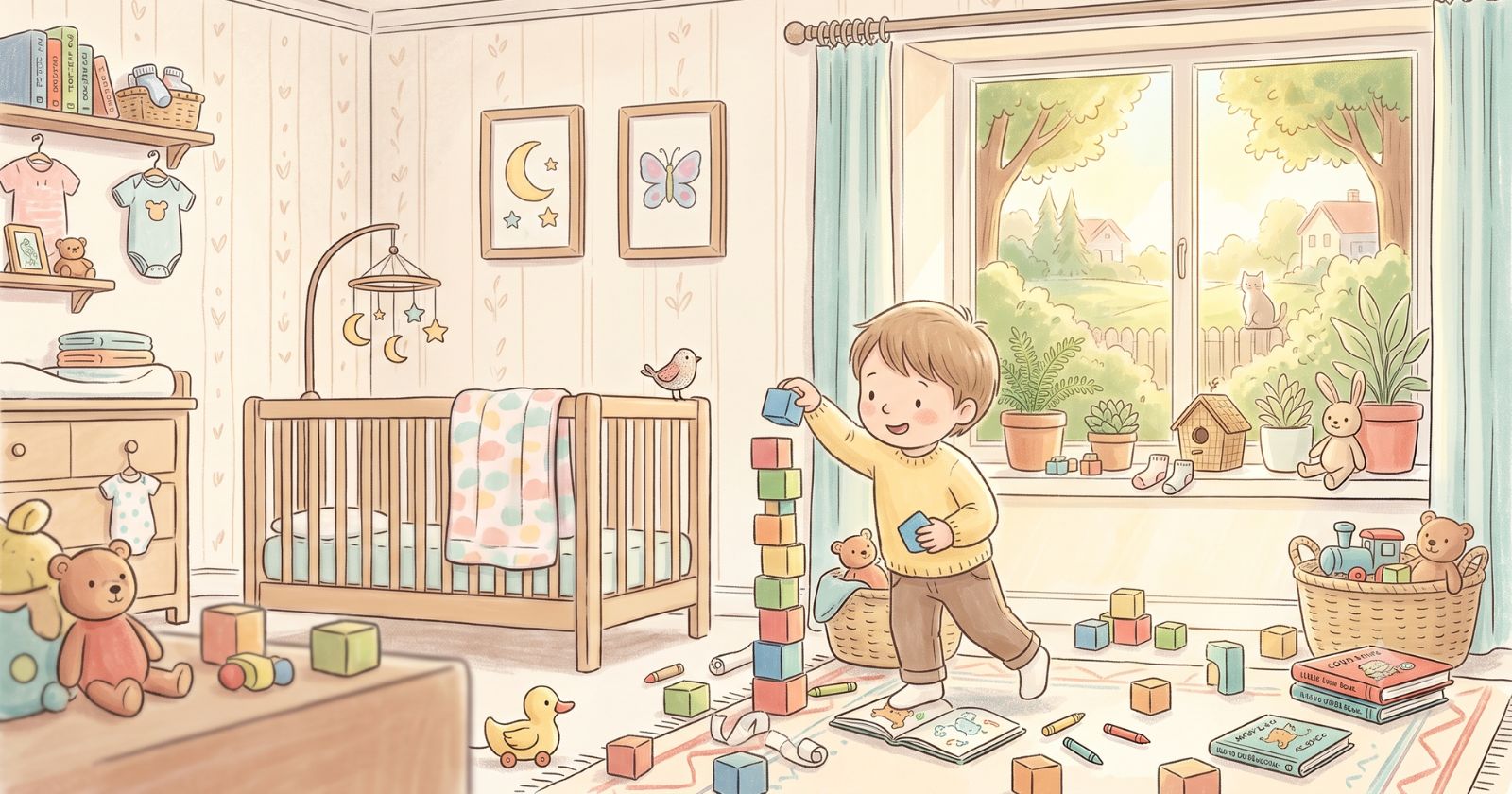
When a new baby arrives, it's easy to feel guilty about an older child's days suddenly looking less "productive." There's less time for planned activities, fewer trips out, more moments of "just get on with something for ten minutes." If that's where you are right now, here's some reassurance: unstructured, child-led play isn't a lesser substitute for proper learning. It's doing real developmental work of its own - arguably work that matters more, not less, during a big family change.
What child-led play is actually doing
Early years practice talks about creating an "enabling environment" - simply, a space where a child has room to:
- work through small problems themselves
- take on a level of challenge they've chosen, not one set for them
- try things that carry a bit of manageable risk
- practise and rehearse a skill until it sticks
A child stacking blocks until they topple, colouring outside the lines on purpose, or inventing their own rules for a game is doing all of this - quietly, without being taught. None of it needs a parent narrating "the point" of the activity for it to count.
Curiosity does most of the work
Children learn fastest through whatever they're already curious about. A child who's fixed on dinosaurs, princesses, diggers, or animals will engage far more deeply with an activity built around that interest than with something more "improving" but less appealing to them. This matters especially in a busy season, because it means you don't have to plan the perfect activity - you just need to notice what your child is drawn to and leave room for it.
This kind of play also tends to meet several needs at once: it can be physical (moving, building, colouring), emotional (processing a big feeling through a story or a drawing), and mentally engaging (working out how something fits together) - all in the same ten minutes. You don't need to separate "learning time" from "feelings time" from "quiet time." Good unstructured play often covers all three.
You don't need to engineer it
The reassuring part is how little unstructured play asks of a tired parent. It doesn't need a plan, a printed activity sheet, or your full attention the whole time. Mostly it needs:
- A bit of time with nothing else scheduled into it.
- A few open-ended materials - crayons, blocks, a cardboard box, whatever's already around.
- Permission for the child to lead, including the "wrong" way to do something.
Why this matters more, not less, right now
During a big transition, it's tempting to think a child needs more structure to feel secure - more routine, more direction, more managed time. Routine helps, but so does protected space where a child gets to be fully in charge of something, however small. That sense of "I decided this, and it worked" builds exactly the confidence a child needs while everything else around them is shifting.
A box of crayons and a quiet page is one of the simplest ways to offer that: no right answer, no correct pace, just a child deciding what happens next.