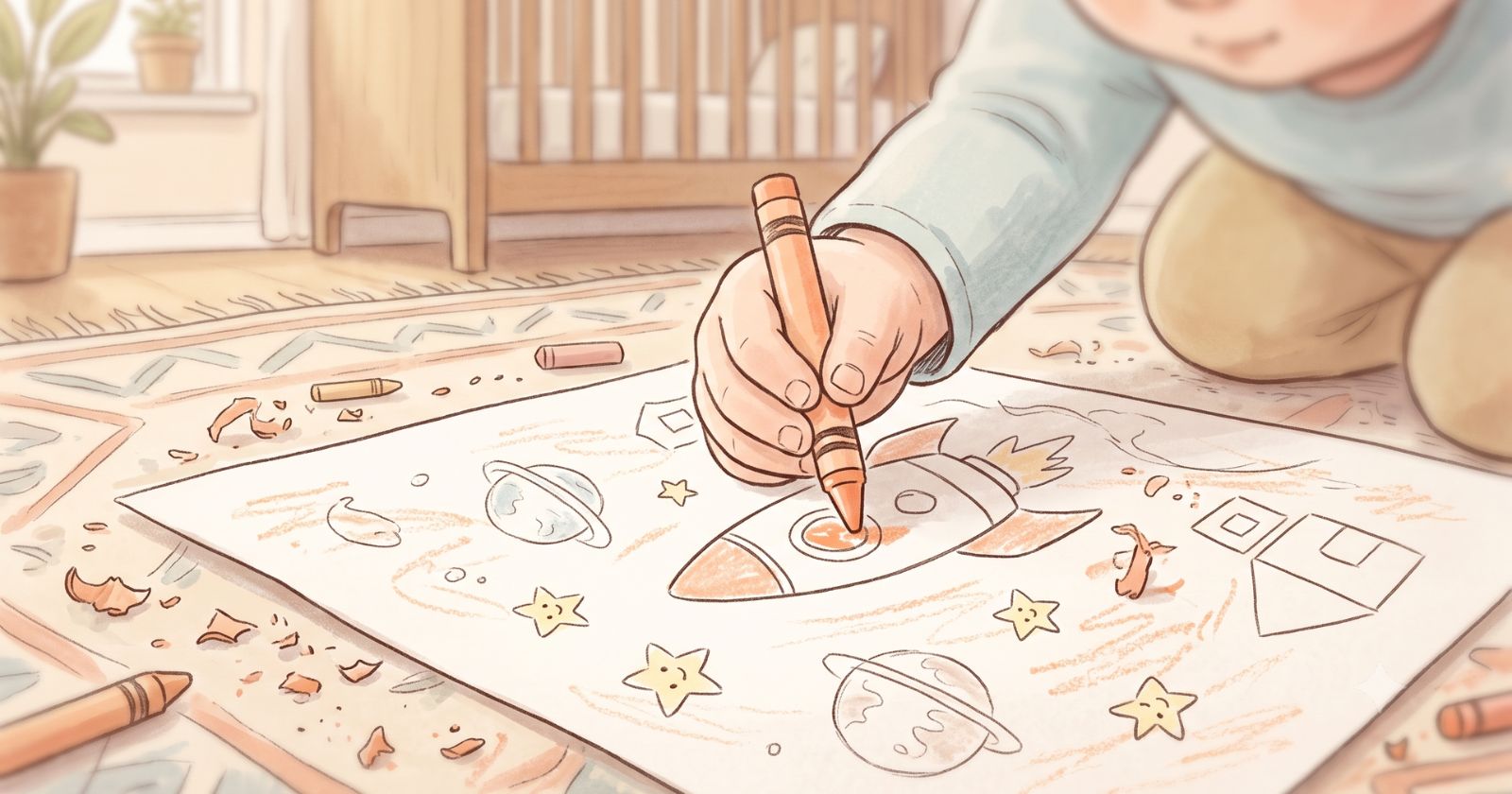
Colouring can look like the simplest possible activity - a distraction, something to keep a child occupied for ten quiet minutes. It's actually doing something much more useful under the surface: building the exact hand strength, control, and coordination a young child will later rely on to hold a pencil and write.
The physical skill colouring is building
Young children don't start with a "correct" way of holding a crayon - grip develops in stages, starting with the whole hand wrapped around it (a fist grip) and gradually refining into more precise grips as hand strength and control improve. The tripod grip most adults use - thumb, index finger, and middle finger working together - is usually one of the later stages, and it develops at a different pace for every child.
Colouring is one of the easiest, lowest-pressure ways to practise this. Every time a child grips a crayon, presses it to paper, and moves it with some control, they're building the small hand and finger muscles that grip strength depends on - without it feeling like practice at all.
Two hands working together
A less obvious skill colouring builds is bilateral coordination: using both hands together, each doing a different job. While one hand colours, the other is usually steadying the page, turning it, or holding it still. This "two hands, two jobs" pattern is a foundational physical skill, and it shows up again later in things like cutting with scissors, tying shoelaces, and even using a knife and fork together.
Hand-eye coordination
Staying (roughly) inside a shape, choosing where a colour goes, following the edges of a picture - all of this asks a child to coordinate what their eyes are tracking with what their hand is doing. This visual-motor link is exactly the skill that later supports forming letters in the right place on a line, which is one of the reasons colouring is often mentioned alongside early writing readiness, even though a child colouring today isn't "doing writing practice."
Why this matters especially now
None of this needs to be turned into a lesson - a child colouring for the fun of it is getting all of these benefits anyway. But it's a nice thing to hold onto during a demanding season, like welcoming a new baby: an activity that's calming, needs almost nothing to set up, and is quietly building a skill your child will use for years, all at the same time.
There's no need to correct grip, insist on staying inside the lines, or treat any of this as a milestone to hit by a certain age. Children develop these skills at their own pace, and simply having regular, relaxed opportunities to colour, draw, and use their hands is what helps that progress along - not pressure to get it "right."